
Solar Radiation Modification (SRM): Common Myths and Claims


Is SRM already happening? Can it ever be governed? We unpack four common myths and claims about SRM, separating fact from fiction and exploring why the technology is so often misunderstood.
Solar radiation modification (SRM) attracts two very different kinds of disagreement. The first is serious debate about whether a set of approaches intended to supplement emissions cuts, carbon removal, and adaptation should ever be used. The second is confusion about what SRM actually is and what’s taking place.
SRM’s potential to affect the global climate raises profound scientific, political, and ethical questions, particularly about who would make decisions and how they would be governed. Yet it is also a new topic for most people, who may first encounter it through news headlines or on social media, where important context and nuance can easily get lost. This creates fertile ground for myths, misconceptions, and misinformation.
What is SRM? A Recap
Also referred to as solar geoengineering, SRM refers to proposed large-scale and intentional efforts to reflect more sunlight back into space to cool the planet and help counteract some climate change impacts. Several approaches are being studied – the two most commonly discussed are stratospheric aerosol injection (SAI) and marine cloud brightening (MCB). Explore this article for more information on the methods.
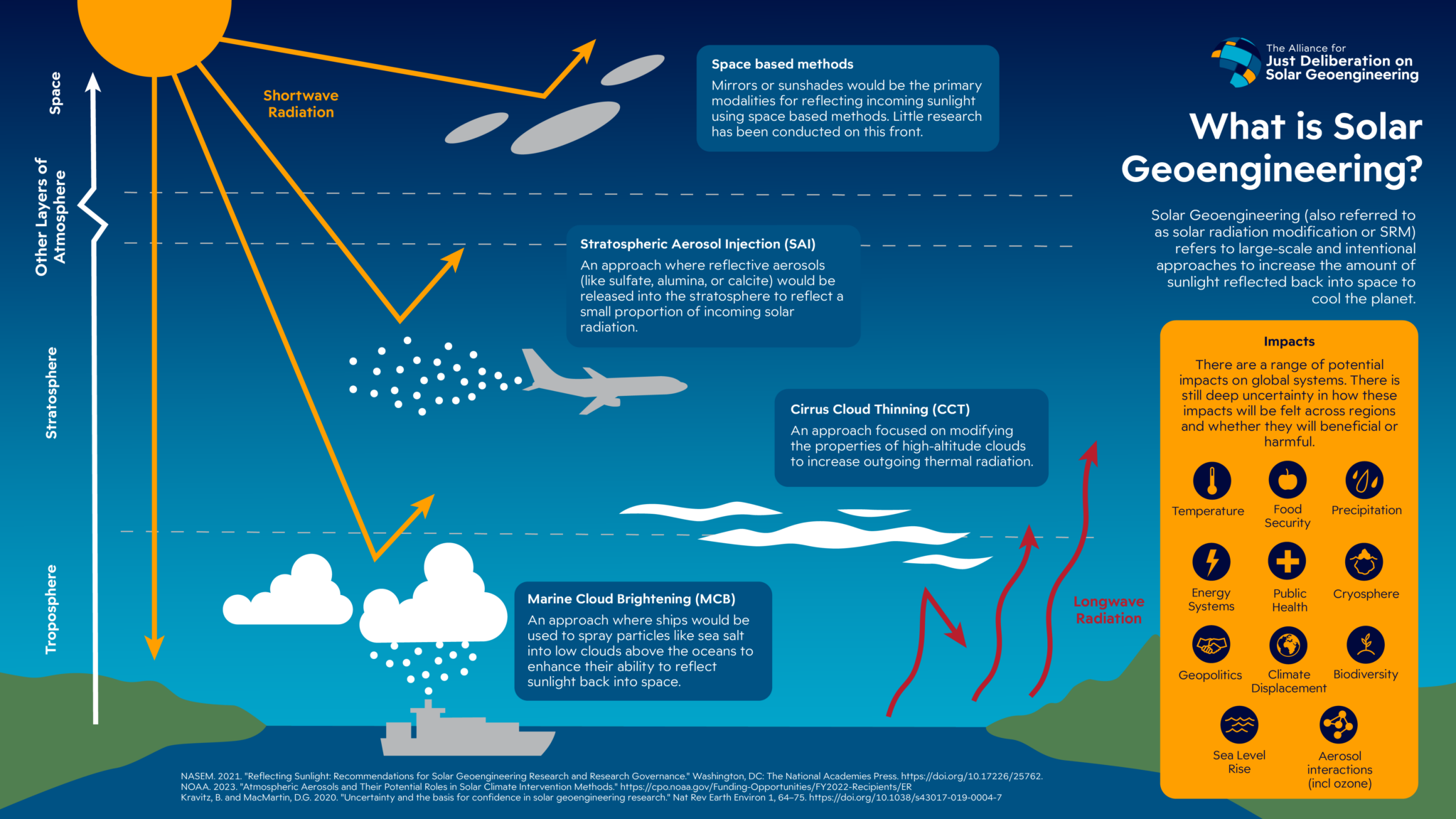
Below, we examine why SRM is so often misunderstood, address three common myths and two disputable claims, and explore how to have a more informed and constructive dialogue about its future.
Why SRM Is So Often Misunderstood
There are several reasons misconceptions about SRM exist. It’s fueled in part by scientific complexity. In a world accustomed to short-form, bite-sized content, understanding the full picture of why SRM is being studied, what it is, and what it may mean for society takes time and attention. A clickable headline or a short post on social media can leave out important parts of the story.
Media coverage often focuses on polarizing actors, controversial research experiments, or worst-case scenarios. While these stories can raise legitimate concerns, they rarely capture the full range of research and perspectives surrounding SRM.
Uncertainty about oversight adds another layer of concern. At present, no centralized governing body or binding international framework exists to oversee SRM’s research or deployment, and there aren’t active oversight or accountability mechanisms either. Without this coordination, it’s hard for the public to see who is doing SRM research, what that research involves, and who’s accountable for it.
To help separate fact from fiction, we’re outlining four common myths and claims below and explaining what the available evidence actually tells us.
Myth 1: “SRM Is Already Happening”
The myth: Governments or private actors are secretly releasing substances unknown to the public into our skies, impacting our health.
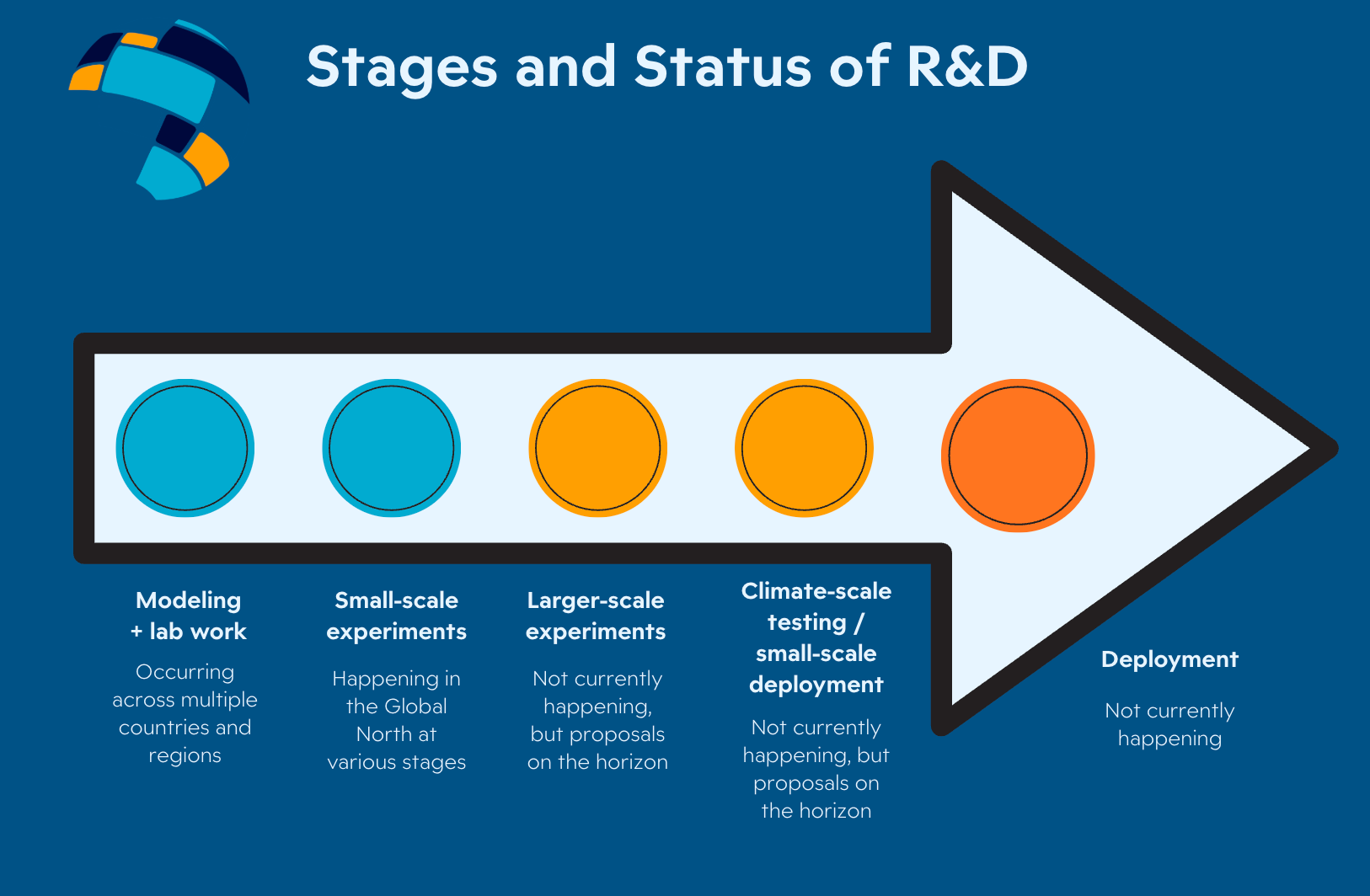
The reality: There is no evidence that SRM is currently taking place at any scale that would meaningfully alter the climate or present a risk. Right now, activity is confined to computer modelling, laboratory studies, and observations of existing natural processes, alongside a small number of proposed outdoor experiments, such as those funded by the UK’s Advanced Research + Invention Agency (ARIA).
One common source of confusion is cloud seeding, an existing form of weather modification. Unlike SRM, cloud seeding takes place on a local scale and aims to enhance precipitation in a particular area. It is not designed to alter global temperatures. In the United States, all weather modification must be reported under the Weather Modification Reporting Act of 1972.
Private-sector activities have also attracted media attention. In 2023, a small private company, Make Sunsets, experienced backlash in Mexico after releasing sulfur dioxide-filled balloons into the atmosphere without government consent. This caused Mexican government agencies to announce an intent to ban all solar geoengineering experiments. The US EPA also requested information from the company in 2025 to assess whether they adhere to the Clean Air Act. Make Sunsets sells “cooling credits,” but there is no evidence that its small-scale releases produce meaningful climate impacts.
More recently, Stardust Solutions, has attracted substantial investment to develop SAI technology by 2030. Stardust has said they would work with governments to deploy when they are ready. While the company has shown limited willingness to be transparent and only started providing documents publicly after public backlash, there is no evidence that the company has deployed SAI at a meaningful scale.
Importantly, private sector initiatives like those of Make Sunsets and Stardust Solutions are isolated. These examples deserve scrutiny, but they should not be confused with deployment. The vast majority of those researching SRM see precaution, further research, and increased governance as critical. This also illustrates why transparency, oversight, and accountability are essential as research develops.
Myth 2: “SRM Means We Can Continue Emitting Fossil Fuels”
The myth: SRM could cool the Earth, buying more time to continue burning fossil fuels without worrying about climate change.
The reality: SRM can never replace emissions cuts, which remain top priority. Climate change is driven by the buildup of greenhouse gases, and SRM does nothing to reduce them. It also does not address climate impacts unrelated to temperature, such as ocean acidification. It acts as a mask until emissions reductions can reduce heating – but it does not solve the underlying problem. That said, SRM could reduce global temperatures and ease some of the worst near-term burdens on communities and livelihoods.
Relying on SRM without substantially reducing emissions could also create serious long-term risks. If a large-scale SRM intervention were abruptly stopped while greenhouse gas concentrations remained high, temperatures would rebound more quickly than under climate change alone. This possibility is referred to as termination shock, which could leave humans, animals, and plants with little time to adapt in certain scenarios.
Another concern is that a focus on SRM could make others less motivated to tackle climate change, an argument known as moral hazard. This may be a risk, but one that can be reduced by further education and understanding that SRM is not a full solution. On the other hand, researchers have observed an inverse moral hazard, where learning about SRM’s risks and limits makes people more determined to cut emissions.
The bottom line: SRM is not a substitute for cutting emissions, and deploying SRM without continuing with significant global emissions reductions would be dangerous. Any consideration of its potential role must begin with that understanding.
Claim 1: “Research and Discussion of SRM Will Inevitably Lead to Deployment”
The claim: Researching SRM is a slippery slope. Doing so gives its deployment a social license and normalizes it, moving one set of interests forward.
The reality: While the future cannot be predicted, understanding a technology does not mandate its use. A slippery slope from research to deployment would be a governance failure, not an inevitable result of doing more science.
Research helps societies make informed decisions about the potential benefits and risks of SRM, including whether it should ever be deployed Several types of research contribute to that understanding:
- Computer modeling predicts and analyzes SRM’s impacts, benefits, and risks.
- Observational studies analyze existing natural processes, such as volcanic eruptions, to understand how aerosols affect the climate.
- Social science research explores the societal, ethical and governance implications.
- Impacts research studies the environmental, social, economic, and health effects.
The concern that momentum forces premature decisions is exactly why DSG is working towards early and inclusive governance. We believe systems should be in place before research findings arrive, so that critical decisions are made deliberately rather than rushed. Clear stage-gates and off-ramps are important to establish before the research is in our hands so that the study of SRM doesn’t lead to use but gives society enough information to say ‘yes’, ‘no’, or ‘not yet’.
Claim 2: “SRM Is Ungovernable”
The claim: It is impossible to govern something like SRM that will impact the entire Earth. Nothing like it has been done before.
The reality: Governing a technology with potentially global consequences would be extraordinarily difficult. But difficulty is not the same as impossibility.
International cooperation on atmospheric issues has succeeded before. In recent history, the world saw great progress made on the protection of the stratospheric ozone layer through the Montreal Protocol. In this case, all United Nations member states were legally bound to phase out ozone-depleting substances, resulting in over 98% phased out globally today. While adding a substance to the stratosphere is different than reducing, it does show that global cooperation with regards to the atmosphere is possible.
And governance is not starting from a blank slate. Organizations have already developed principles for responsible research and DSG is working alongside the Council on Energy, Environment and Water, the American Geophysical Union, and NRDC to turn these principles into practical, usable tools through the Solar Geoengineering Research Governance Platform (SGRG). Efforts like this are the start of a practical, bottom-up approach to governance that must continue to expand.
The possibility that a powerful country or actor could act unilaterally remains a serious concern. But that is an argument for stronger governance and monitoring systems that make it harder, rather than to forgo trying. Governing a planetary intervention like SRM would be incredibly difficult, but it’s premature to say it’s impossible. Now is the time to build systems, before decisions arise.
The Real Trade-Offs SRM Raises
Correcting misconceptions is important, but it is only the beginning. Beyond the myths and common claims are the truly pressing considerations that stakeholders grapple with. Three tensions deserve particular attention.
Climate risk vs. SRM risk: SRM is being considered because of the risks climate change poses, which will continue to grow without sufficient action. Understanding whether SRM is a good idea requires weighing the risks of climate change and the risks of SRM side by side. This includes scientific, political, and governance risks. The comparison is hard to make given the risks differ in type and fall on different people and places. Continued work needs to be done to understand and compare these risks so that they can be usefully framed for decision-makers.
Privatization vs. public good: This has become a particularly important point this past year, given the large amount of funding awarded to private companies, as mentioned above. It has opened a debate about where it is appropriate for profit-driven entities to play a role, when the variable at hand is one of the most obvious public goods - the atmosphere. From DSG’s perspective, profit motives risk distorting priorities, undermining trust, and deepening global inequities. Others see private capital as necessary to scale research and investigation.
Speed vs. precaution: On SRM in particular, the balance between moving quickly and moving carefully is delicate. This is one that DSG grapples with often. The climate crisis demands urgency to prevent further damage and suffering, but we believe that developing responsible research and governance takes time, care, and careful consultation. Others see accelerated action as imperative and want to accelerate, even if it means setting principles aside. How the field moves forward, and how quickly, if it does at all, requires deliberate thought and consideration.
As the field attempts to come closer to answering these questions, it’s important to consider who is asking them. The decisions made are important governance choices that will determine and shape how SRM is discussed, who discusses it, to what extent, and to which outcome. Conversations and forums that include affected communities and broad sets of stakeholders are more likely to surface the impacts that matter most but have been heard the least.
How to Improve the SRM Conversation
SRM is a challenging topic to understand and is not helped by misconceptions that surround it. To keep learning in ways that are evidence-based, we suggest:
Looking for science-based language and framing. Be wary of decisive headlines that cast SRM as either a miracle cure or a catastrophe waiting to happen. Neither will share a balanced story. Strong sources explain terms plainly, help you understand scientific or ethical arguments, and leave the debate open.
Ask whether a claim is a fact or a value judgement. Some questions have clear answers, such as whether SRM will solve climate change (it won’t), but others come down to values. Perspectives on SRM are often informed by one person's ideas of the role of technology, the relationship between humans and nature, and how much risk they are willing to accept. Understanding whether you are looking at a fact or value judgement makes it easier to form your own opinion.
Keep SRM within the bigger picture. These debates should be taking place alongside other climate and policy conservations. SRM’s risks cannot be judged on their own and their consideration should be held within the context of the ever-changing world.
Do you want to continue learning more and building your understanding of the topic? Subscribe to our newsletter.
Join Our Community
Stay informed about the latest developments in solar geoengineering and how you can make a difference. Subscribe to our newsletter for insights, updates, and opportunities to get involved.
Latest Posts
Solar Radiation Modification (SRM): Common Myths and Claims

Risks and Benefits of Solar Geoengineering Explained

Big ambitions, bigger questions: Our takeaways from Reykjavik


Solar geoengineering: What is it? A plain-language guide.
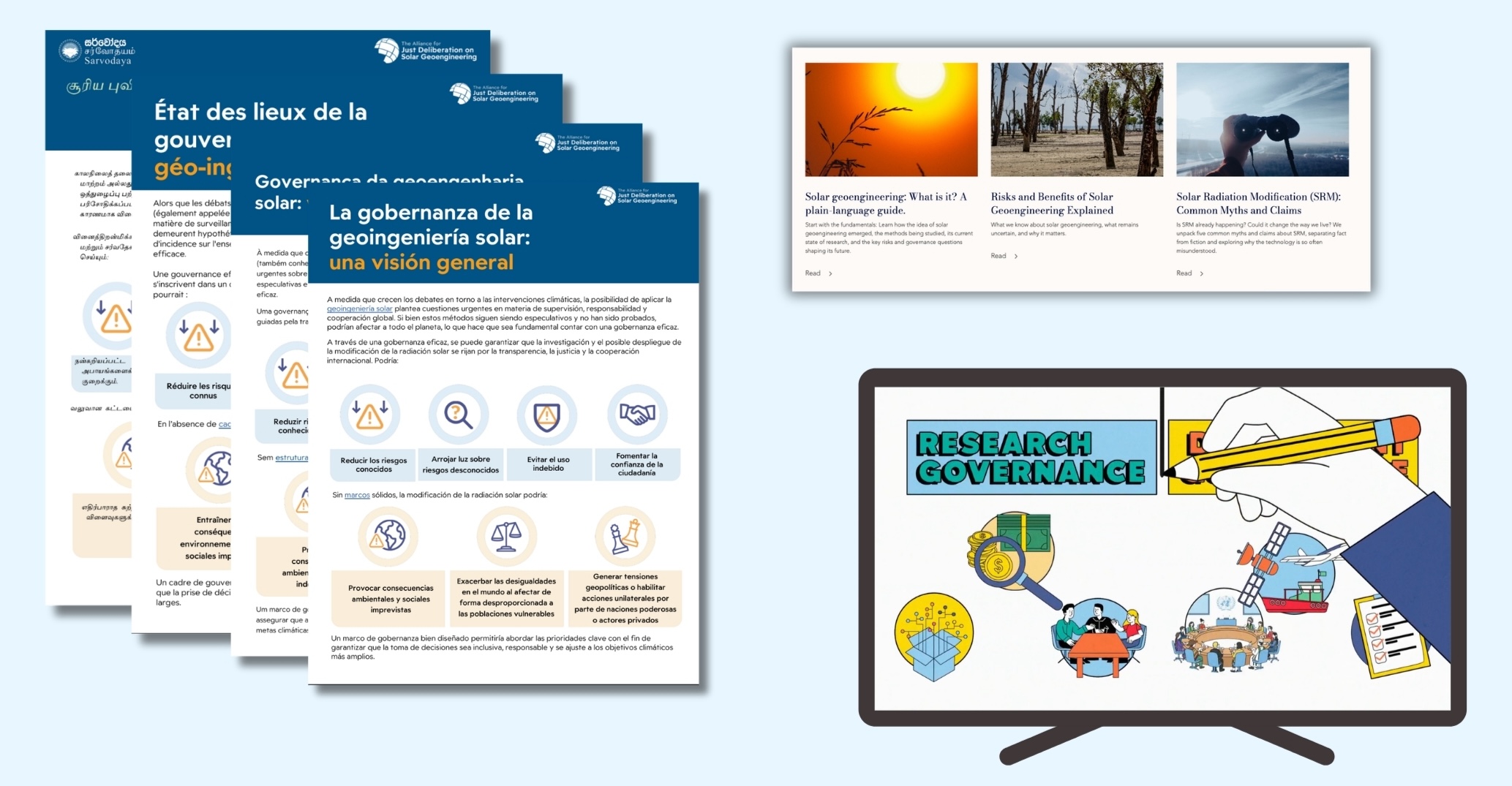
DSG expands solar geoengineering learning resources with new languages, videos, and explainers
Before the Rules Catch Up: What AI’s Pace and Safety Challenges Mean for SRM Governance